
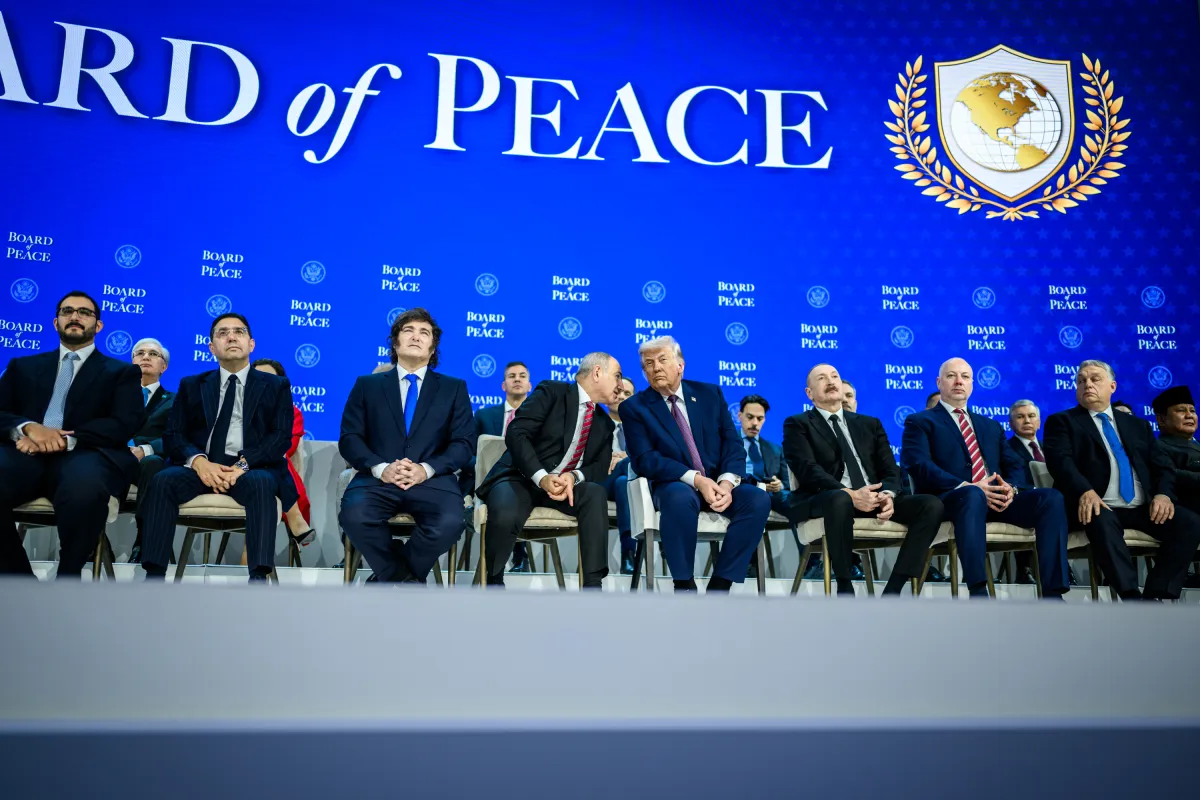
The international spotlight has turned to Washington today, where President Donald J. Trump is chairing the inaugural session of the newly formed “Board of Peace” at the United States Institute of Peace, recently renamed in his honor.
The meeting marks the most consequential diplomatic effort since the fragile October 2025 ceasefire in Gaza. What unfolds here could determine whether that ceasefire evolves into lasting stability or unravels under political strain.
From Ceasefire to Reconstruction
The Board of Peace was created under UN Security Council Resolution 2803 to oversee Phase II of the Gaza ceasefire. Its mandate is ambitious: supervise the full demilitarization of Hamas and coordinate the reconstruction of Gaza after more than two years of war.
The scale of the task is immense. Rebuilding homes, hospitals, water systems, power grids, and telecommunications infrastructure is expected to cost more than $70 billion.
At the opening session, President Trump announced that member states have pledged $5 billion as an initial “down payment.” Internal briefings confirm that $2.4 billion of that total comes from a combined pledge by the United Arab Emirates and Kuwait, signaling that Gulf states are prepared to anchor the early financial effort.
Even so, the pledged amount represents only a first step toward the far larger reconstruction target.
The Architecture of the Board
President Trump serves as permanent chair of the Board. Operational responsibilities fall to a Gaza Executive Board that includes figures such as Jared Kushner, Tony Blair, and U.S. envoy Steve Witkoff.
More than 40 countries are represented at the inaugural session. Among them are Israel and key regional actors including Saudi Arabia, Turkey, Egypt, Qatar, Jordan, the United Arab Emirates, Pakistan, Indonesia, and Kuwait.
Several major Western powers, however, have chosen not to formally join. France, the United Kingdom, and Germany remain outside the Board, expressing concern that its structure may sideline established United Nations mechanisms. The European Union has sent observers rather than active participants.
Critics have described the initiative as resembling a “Private UN,” pointing to its governance model particularly the permanent chairmanship and financial entry requirements as unconventional.
Indonesia’s Strategic Intervention
Among the participants, Indonesian President Prabowo Subianto has emerged as a central figure.
Indonesia is the only country so far to make a firm military commitment to the proposed International Stabilization Force (ISF), pledging up to 8,000 peacekeepers, with 1,000 prepared for deployment as early as April.
The ISF’s mission would be to maintain order, oversee the disarmament process, and create stable conditions for reconstruction. Indonesia and Egypt are reportedly advocating for a strictly humanitarian and policing mandate, rather than a combat focused role.
At the same time, President Prabowo is finalizing a $38.4 billion memorandum of understanding with the United States focused on reciprocal trade. Analysts view Indonesia’s leadership in Gaza as both a diplomatic and economic calculation strengthening its global standing while expanding trade ties beyond China.
The “Group of 8”: A Middle Eastern G7
A core bloc informally referred to as the “Group of 8” has become the driving force behind Phase II of the Gaza plan. It includes Indonesia, Saudi Arabia, Turkey, Egypt, Jordan, Qatar, the United Arab Emirates, and Pakistan.
In practical terms, this bloc is operating much like a Middle Eastern version of the G7: a compact group of influential regional powers coordinating policy, funding, and security decisions largely independent of traditional Western leadership structures.
Each country brings leverage:
- Saudi Arabia and the UAE are central financial backers, with Kuwait now joining that financial core.
- Turkey, Qatar, and Egypt maintain communication channels with Hamas and are essential to any credible demilitarization effort.
- Jordan and Pakistan contribute peacekeeping expertise and regional depth.
- Indonesia provides the largest troop commitment to date.
Their presence signals that the diplomatic center of gravity, at least in this forum, has shifted away from Western capitals and toward a coalition of Islamic majority states working directly with Washington.
Israeli and European Reservations
Israel is formally a member of the Board, but Prime Minister Benjamin Netanyahu did not attend the session, delegating representation to Foreign Minister Gideon Saar. Domestically, Netanyahu faces pressure from coalition partners opposed to any arrangement that resembles international oversight of Gaza.
Meanwhile, tensions in the West Bank continue to cast a shadow over the proceedings. Recent land registration moves in Area C have drawn warnings from the United Nations that prospects for a two state solution could be further weakened.
For European governments, the concern is institutional as much as political. The Board’s permanent leadership model and financial structure depart from established multilateral norms. As a result, traditional Western allies remain cautious, watching closely but staying formally outside the framework.
Inside the Room: A Live Moment
As the session enters its final hour in Washington, the focus has narrowed to the practical details of how this plan would actually work.
Military representatives are now discussing the mechanics of troop command who answers to whom, how decisions will be made, and what peacekeepers are allowed to do if violence resumes.
The language is technical, but the stakes are clear:
without clear rules, even a large peacekeeping force could struggle on the ground.
At the same time, the Gaza Executive Board is outlining its “Gaza 2026” roadmap. The priorities are basic but urgent restoring water, electricity, and communications before attempting broader economic reforms.
A joint statement, expected to be called the “Washington Declaration,” is anticipated within hours. Its wording will matter. It will signal whether this initiative is meant to complement the United Nations system or quietly operate alongside it as a new center of global coordination.
A Diplomatic Test Case
The mood inside the institute is focused and pragmatic. Outside, security is tight, and skepticism remains visible among protesters and UN aligned observers.
This initiative represents more than a reconstruction effort. It is also a test of whether a coalition led by Washington and major Islamic powers can reshape how post conflict governance is managed.
If funding materializes, troop deployments proceed smoothly, and demilitarization holds, the Board of Peace could redefine diplomatic power structures in the region.
If it falters through political division, financial shortfalls, or renewed violence the consequences could extend far beyond Gaza.
For now, the world is watching Washington. The pledges have been made. The question is whether they will translate into durable stability.