
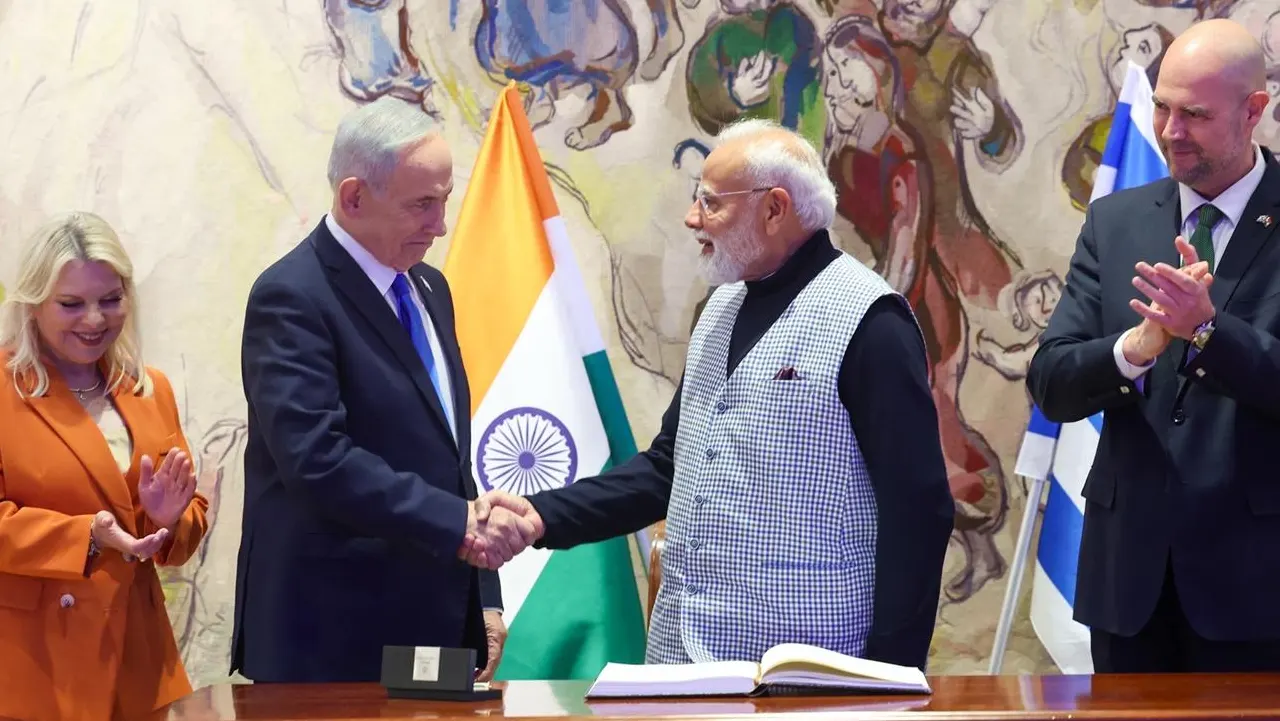
Modi in Israel: A Short Visit With Long Shadows
When Narendra Modi stood inside the Knesset and declared,
“No cause justifies killing civilians,” it was more than a moral statement.
It was a calibrated geopolitical signal.
In one sentence, he acknowledged humanitarian anguish in Gaza.
In the same speech, he reaffirmed India’s “firm conviction” and solidarity with Israel. Hours later, he became the first Indian Prime Minister to receive the Speaker of the Knesset Medal, the parliament’s highest honor.
That sequence wasn’t accidental.
In just 48 hours, February 25–26, 2026 Narendra Modi didn’t merely conduct a state visit to Israel. He reshaped how India presents itself in
one of the world’s most combustible regions.
So what really happened ? And why does it matter far beyond Jerusalem?
The Moral Anchor: A Line That Traveled the World
The quote “No cause justifies killing civilians” instantly became the defining line of Modi’s address.
It worked on multiple levels:
- It reassured Arab nations that India is not endorsing unlimited military force.
- It reinforced India’s long standing support for a just and durable peace.
- It addressed domestic critics who feared New Delhi was drifting too close to Israel.
Yet, crucially, Modi did not dilute his support for Israel’s right to security.
This is what analysts are calling “de hyphenated diplomacy.”
For decades, India treated Israel and Palestine as diplomatically linked progress with one required balancing gestures toward the other.
Under Modi, the approach has evolved: engage both, but independently.
It’s a subtle shift but in diplomacy, subtle shifts change entire trajectories.
A Historic First: The Knesset Medal
Moments after his speech, Modi received the Speaker of the Knesset Medal, the first Indian prime minister ever to do so.
Symbolism matters in statecraft. Medals aren’t just ceremonial,
they represent institutional trust.
The message from Israel was clear:
India is no longer just a defense customer. It is a strategic partner.
Defense: From Buyer-Seller to Co Architect
If the speech was the emotional high point, the defense agreements were the structural pivot.
For years, India has been one of Israel’s largest arms buyers. But this visit marks a transition toward co production, technology transfer, and classified collaboration.
Estimates place the total value of upcoming defense agreements between $8 billion and $10 billion.
That’s not incremental. That’s transformational.
Iron Dome and Mission Sudarshan Chakra
At the heart of the discussions is Israel’s Iron Dome, a short range air defense system that intercepts rockets and drones mid flight.
Here’s what makes this different:
- Israel has offered technology transfer under India’s “Make in India” initiative.
- Integration into India’s indigenous air defense shield, Mission Sudarshan Chakra (also known as Project Kusha).
- Co development rather than simple procurement.
In plain terms: India wants to build its own protective canopy using Israeli expertise.
And then there’s Iron Beam, a laser based interceptor capable of destroying drones for roughly $2 per shot.
Why is that important ?
Modern conflicts increasingly rely on cheap drones. Using expensive interceptor missiles to shoot them down creates what military planners call a “cost exchange imbalance.” Laser systems fix that problem.
This is about future proofing India’s air defenses against swarm warfare.
The Hypersonic Edge: “Golden Horizon”
Perhaps the most intriguing development is the reported discussion around a next generation hypersonic missile called Golden Horizon
a Mach 5+ successor to Israel’s Sparrow missile family.
Mach 5 means five times the speed of sound. At those speeds, interception becomes extremely difficult.
If integrated into India’s Sukhoi-30MKI fleet, Golden Horizon could provide:
- Long range precision strike capability (estimated 1,000–2,000 km)
- Stand off attack options without entering hostile airspace
- A credible deterrent against advanced adversaries
Hypersonic systems are at the cutting edge of modern warfare.
Few nations possess them.
If finalized, this would significantly elevate India’s deterrence posture.
Missiles, Refuelers, and Drones
Other reported components include:
- Expansion of Rampage and Air LORA supersonic strike missiles
- Naval cruise missile upgrades
- Conversion of six Boeing 767 aircraft into mid air refueling tankers
- A substantial contract for Hermes 900 surveillance drones
There’s also a new “Classified Security Framework” allowing sensitive technology sharing something previously restricted.
However, a caveat: many Israeli systems contain U.S. components.
That means American approval may be required for certain transfers.
Geopolitics, as always, is layered.
The “Hexagon Alliance” and Strategic Autonomy
Israeli Prime Minister Benjamin Netanyahu proposed a broader
“Hexagon Alliance” linking Israel, India, Arab states, African nations,
and Mediterranean partners.
Modi welcomed technological collaboration in AI, semiconductors, and quantum computing.
But he stopped short of endorsing a formal military bloc.
Why?
Because India’s core doctrine remains Strategic Autonomy,the ability to cooperate widely without entering binding alliances.
India engages in the Quad, BRICS, and I2U2. But it avoids permanent military commitments.
This isn’t neutrality. It’s leverage.
IMEC and Economic Strategy
Defense dominated headlines, but economic integration is equally significant.
Both leaders reaffirmed commitment to the India-Middle East-Europe Economic Corridor (IMEC), a connectivity initiative designed to link India to Europe via Gulf nations and Israel.
In a world where supply chains are increasingly politicized, alternative trade corridors are strategic assets.
Negotiations on a comprehensive Free Trade Agreement are also accelerating, covering AI, cybersecurity, green tech, and quantum research.
The message is clear: this partnership extends beyond weapons.
Domestic Backlash in India
Not everyone at home is applauding.
The Congress party criticized the visit, arguing that it sidelines India’s historical support for Palestine. They revived a 1947 letter from Jawaharlal Nehru to Albert Einstein in which Nehru expressed sympathy for Jewish suffering but questioned Arab alienation.
Opposition leaders also objected to Modi referencing that India recognized Israel on September 17, 1950, the same day he was born calling it symbolic reframing of history.
This debate reflects a broader divide:
- Nehruvian Non Alignment: Moral positioning and balanced distance.
- Modi-Era Realism: Strategic interest and capability building.
The argument isn’t just about Israel. It’s about India’s identity.
Global Optics: Bridging the “Isolation Gap”
For Netanyahu, the visit offered diplomatic oxygen amid mounting international pressure.
For Modi, it reinforced India’s ambition to be a “middle power”, a nation capable of engaging all sides of a conflict.
He referenced a UN backed Gaza peace pathway, signaling that India is not issuing a blank check.
This is tightrope diplomacy.
The Symbolism of Yad Vashem
On the second day, Modi visited Yad Vashem, Israel’s Holocaust memorial.
Such visits are deeply symbolic. They acknowledge historical trauma while reinforcing contemporary partnership.
Diplomacy is as much about memory as it is about missiles.
So What Does This All Mean ?
Let’s step back.
In 48 hours, Narendra Modi:
- Delivered a morally anchored speech at the Knesset.
- Received the parliament’s highest honor.
- Advanced defense deals worth up to $10 billion.
- Explored hypersonic missile cooperation.
- Reaffirmed economic corridor commitments.
- Positioned India as a middle power capable of multi alignment.
That’s not routine diplomacy.
It’s strategic repositioning.
Pragmatism Over Posture
we used to think foreign policy shifts were dramatic, a break from the past, a sharp turn.
But what Modi demonstrated in Israel is something subtler: evolution rather than rupture.
India still supports a two state solution. It still engages Arab capitals.
It still values its energy partnerships.
But it is also accelerating defense integration and technological cooperation with Israel.
The myth is that India must choose sides.
The reality is that India is choosing autonomy.
Narendra Modi’s visit wasn’t about abandoning old principles. It was about redefining how those principles operate in a multipolar world.
And whether critics call it strategic realism or diplomatic risk, one thing is certain:
India is no longer a cautious observer in West Asia. It intends to shape the outcome.