
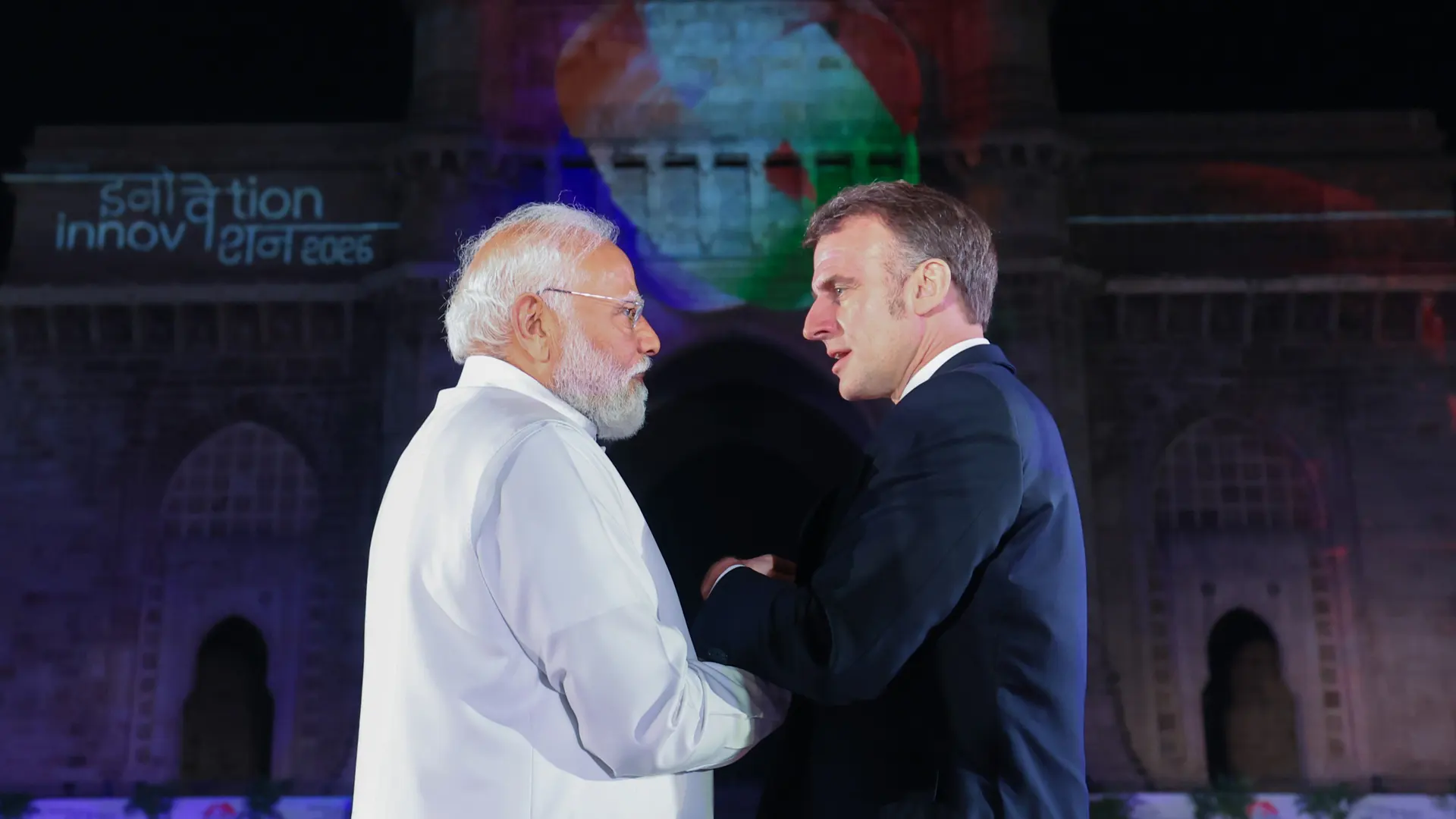
French President Emmanuel Macron is in India this week for a three day state visit (February 17–19, 2026) that could shape not only bilateral ties, but Europe’s wider economic strategy. The visit formally elevates relations with Prime Minister Narendra Modi to a “Special Global Strategic Partnership,” centered on defense, artificial intelligence, clean energy, and industrial cooperation.
The visit’s choreography half spectacle, half summitry reflects the high stakes. In Mumbai, the tone was warm and highly visible. A car ride through busy city streets produced a viral photograph captioned “Jai Ho,” signaling personal chemistry between the two leaders. But as Macron moved on to New Delhi and the India AI Impact Summit 2026, the mood shifted from symbolism to strategy. Behind the public gestures lies a detailed plan to reshape how France, India, and Europe position themselves in a more competitive world.
Beyond the Title: A Strategic Recalibration
Beyond the new title lies a fundamental recalibration: moving away from a traditional buyer seller defense relationship toward long term
co development in advanced sectors.
The partnership is anchored in a Horizon 2047 roadmap, stretching to the 100th anniversary of Indian independence. It introduces structured oversight, including an annual foreign ministers’ dialogue, to keep the agenda on track.
Its economic engine is the “Roadmap of Shared Prosperity,” which aims to double bilateral trade by 2030. A key development is the signing of an Amending Protocol to the Double Tax Avoidance Agreement (DTAA).
The update specifically lowers tax rates on royalties and fees for technical services precisely the areas where startups and technology firms have faced friction. By reducing these costs, both governments are signaling that cross border innovation should become easier, not harder.
The roadmap also commits both sides to building “trusted and resilient” supply chains, explicitly seeking to “de risk” to use Brussels’ preferred term from single source suppliers.
The 2026 Year of Innovation
The 2026 India–France Year of Innovation was launched at the Gateway of India in Mumbai. The symbolism was deliberate: a historic landmark framing a forward looking agenda.
Three pillars define the initiative:
Green Technology. Cooperation will focus on green hydrogen, low carbon industrial solutions, and access to critical minerals. A Joint Advanced Technology Development Group has been formed to identify niche clean energy breakthroughs.
Space and Commercial Ecosystems. The focus has expanded from satellite launches to building commercial space markets. The French firm Exotrail signed contracts with Indian space companies for electric propulsion systems. The ambition is to make “Indo-French” a global benchmark in space technology.
Healthcare and Biotechnology. Research networks are expanding into antimicrobial resistance, metabolic diseases, and digital health platforms.
Artificial intelligence sits at the center of this agenda. Speaking at the AI Impact Summit in New Delhi, Macron emphasized building AI systems that respect democratic values. He described a “Marseille to Mumbai” axis an attempt to position France and India not only as AI adopters, but as global standard setters.
Defense: From Procurement to Production
Defense remains a core pillar, but it is evolving toward industrial partnership.
The visit confirmed continued collaboration on Rafale aircraft and the Scorpène submarine program. A new Maintenance, Repair, and Overhaul facility for Rafale engines has been inaugurated, strengthening India’s domestic aerospace capacity.
In a more symbolic step, the leaders virtually inaugurated the H125 helicopter final assembly line in Vemagal, Karnataka the first private sector helicopter manufacturing facility in India. The project is a joint venture between Airbus and Tata Advanced Systems. The message is clear:
this is no longer about selling platforms, but about building them together.
Meanwhile, Thales has integrated India into its global research network, launching a Bengaluru hub focused on embedded AI and cybersecurity.
Taken together, these moves point toward shared industrial capability
an approach designed to strengthen sovereignty on both sides.
Evian, Nairobi, and the Bridge Strategy
Macron’s invitation to Modi to attend the 52nd G7 Summit in Evian later this year carries broader strategic meaning. France chairs the G7 in 2026, while India chairs the BRICS summit. Macron has proposed advance coordination meetings to align positions on climate finance and debt reform, effectively encouraging India to act as a bridge between major economic blocs.
The cooperation extends further. Both leaders will co-host the
“Africa Forward” Summit in Nairobi on May 11–12, 2026. The goal is to present Indo-French innovation especially in clean energy and digital infrastructure as practical solutions for African development.
France has also reaffirmed its ambition to welcome 30,000 Indian students by 2030, supported by a Young Professionals Scheme to ease talent mobility. Human capital is being treated as a strategic asset.
Paris vs. Berlin: The Industrial Debate
While Macron builds partnerships abroad, he faces a decisive debate at home. On February 25, the European Commission will unveil its Industrial Accelerator Act, a proposal that could redefine EU industrial policy.
Macron is pushing for a strict “Made in Europe” requirement in strategic sectors such as cleantech, defense, AI, and critical chemicals.
His argument is blunt: without stronger protection, European industry risks being “swept aside” by Chinese state subsidies and unstable global trade conditions.
German Chancellor Friedrich Merz advocates a more flexible “Made with Europe” approach. His model would integrate trusted partners like India into European supply chains rather than restrict participation to the European Economic Area alone.
This is not a minor policy disagreement. It is a philosophical clash between Paris and Berlin over whether sovereignty requires tighter borders or smarter partnerships.
The India visit provides Macron with a practical example. By showcasing co development such as the Vemagal helicopter facility and joint AI research, he can argue that Europe can protect its core industries while still building trusted external alliances.
The “Evian to Nairobi” Axis: A Global Reset ?
President Macron’s trip is being described as a watershed moment. Whether it becomes one depends on execution.
The warmth of Mumbai’s public moments stands in contrast to the cold industrial logic shaping negotiations in New Delhi and Brussels. Yet both scenes are connected. Personal rapport helps unlock political trust; political trust enables industrial strategy.
With the European Commission’s proposal due on February 25, a ticking clock now frames the broader debate. If Macron succeeds in reshaping EU industrial rules, the partnership announced this week could become a model for how Europe engages the Indo-Pacific:
protective where necessary, collaborative where possible.
If not, the ambitious language of a “Special Global Strategic Partnership” may face early limits.
For now, France and India are presenting a shared message:
in a fragmented global economy, sovereignty may depend less on isolation and more on carefully chosen alliances.