
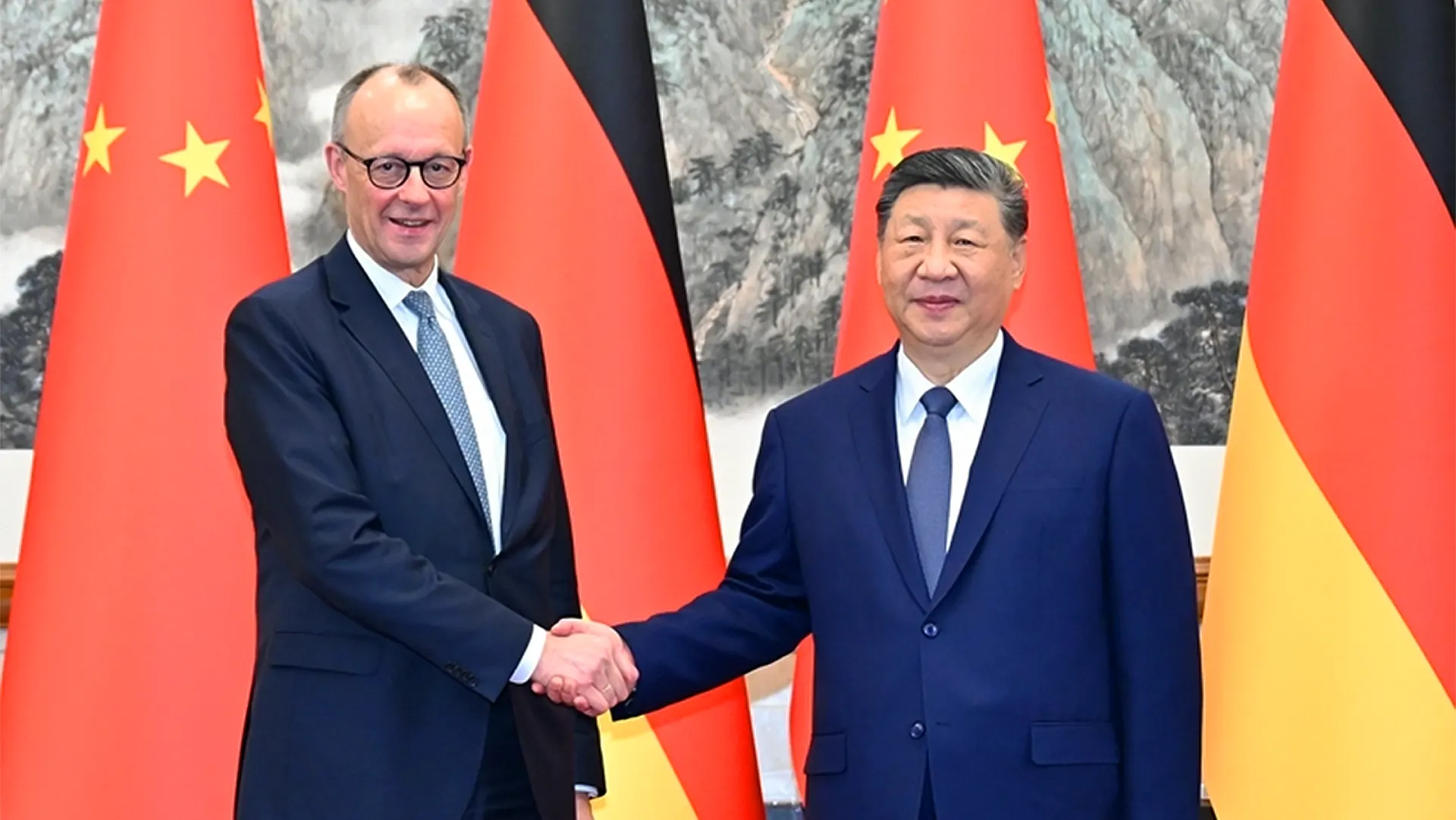
When Chancellor Friedrich Merz landed in Beijing on February 25, 2026, he wasn’t just beginning a diplomatic trip. He was signaling a shift in Germany’s global strategy.
After years of labeling China a “systemic rival,” Berlin is now leaning toward a more pragmatic approach. And Merz didn’t arrive alone.
He brought 30 of Germany’s most powerful CEOs including leaders
from Volkswagen, BMW, Mercedes Benz, and Siemens.
This visit marks a clear “reset” in Germany-China relations one driven by economic survival as much as political calculation.
Here’s what’s really happening.
The Airbus Deal: A Tangible Win on Day One
Within hours of arriving, Merz secured a headline grabbing agreement: China will order up to 120 aircraft from Airbus.
That’s not just a business contract. It’s leverage.
The Airbus breakthrough instantly gave Merz proof that engagement with China can produce concrete economic gains.
For a German economy struggling with weak consumer confidence and slowing exports, this deal matters. It supports European aerospace jobs and strengthens Berlin’s hand ahead of upcoming talks in Washington.
Merz framed the visit around what he calls a “balanced, reliable, and fair” partnership. But balance is the key word.
The Trade Imbalance Problem
The numbers tell a complicated story.
In 2025, China reclaimed its position as Germany’s top trading partner, with total trade reaching €251.8 billion surpassing the United States.
But here’s the catch:
- German exports to China fell nearly 10%
- Imports from China surged almost 9%
- Germany’s trade deficit with China approached €90 billion
Germany is deeply dependent on Chinese imports especially
electronics, machinery, and rare earth materials critical for
green energy technologies.
China controls roughly 90% of global rare earth processing.
That gives Beijing enormous influence over supply chains tied to electric vehicles and renewable energy.
Merz isn’t ignoring this risk. Instead, he’s walking a tightrope.
De Risking, Not Decoupling
Washington is pushing for “decoupling” a sharp reduction of economic ties with China. Merz is rejecting that idea.
Instead, he’s promoting “de risking.”
What’s the difference ?
Decoupling means cutting economic ties. De risking means reducing dangerous dependencies while keeping trade flowing.
Merz’s message is clear: Germany won’t join a U.S.-led economic divorce from China but it wants fewer vulnerabilities.
This approach reflects what many are calling the “Merz Doctrine”:
interest based diplomacy over ideological confrontation.
The “Trump Factor” and the Tariff Threat
This shift isn’t happening in a vacuum.
Just days before Merz’s Beijing trip, President Donald Trump imposed a 15% tariff surcharge under Section 122 of the U.S. Trade Act. That move effectively broke the 2025 “Turnberry Agreement,” which had frozen tariff escalations between the U.S. and EU.
German exports to the U.S. are already down nearly 9%. And if tariffs rise further, Germany’s auto industry could face serious damage.
Caught between Chinese overcapacity and U.S. tariffs, German industry is feeling a two way squeeze.
For automakers like BMW and Mercedes Benz, China is not optional.
It is the primary profit engine. That’s why their CEOs joined Merz in Beijing not as spectators, but as strategic stakeholders.
Increasingly, German companies are adopting an “in China, for China” model. They’re investing locally to shield profits from transatlantic tariff wars.
In 2025 alone, German investment in China jumped 55% to €7 billion. Meanwhile, investment in the U.S. nearly halved.
That shift speaks volumes.
Strategic Autonomy: The Bigger Picture
Merz previewed this new direction at the Munich Security Conference, where he argued that Europe must stop acting like a dependent satellite of any superpower.
He criticized what he called Germany’s past “normative surplus” spending too much time lecturing others on values without building the economic and military strength to back it up.
His argument: Europe can only negotiate with Washington and Beijing as an equal if it can defend and sustain itself independently.
In Beijing, that philosophy translates into economic pragmatism.
In Washington next week, it will likely translate into hard bargaining.
Merz is essentially saying: Germany has options.
The Risks of the “Third Way”
Of course, this strategy carries danger.
If Washington views Germany’s outreach to China as accommodation, further tariffs could follow. At the same time, not all EU countries support Merz’s pivot. Nations like Poland and Lithuania worry that economic pragmatism could weaken a united Western front.
Meanwhile, China is eager to keep Europe open. Facing 100% U.S. tariffs on electric vehicles and heavy restrictions on tech exports, Beijing sees Germany as a potential “stabilizing anchor” in its relationship with the EU.
That makes Berlin powerful but also exposed.
Merz is walking a razor thin line between economic necessity and geopolitical loyalty.
What Comes Next?
Merz’s upcoming visit to Washington will test whether this “Third Way” can hold.
Armed with the Airbus deal and strong trade ties with China, he will argue that Germany cannot afford permanent 15% U.S. tariffs on its cars and machinery.
If talks fail, Europe may deepen economic integration with Asia not out of ideology, but out of necessity.
For now, one thing is clear:
Germany’s foreign policy is no longer about choosing sides. It’s about maximizing leverage in a world of competing powers.
And Friedrich Merz’s Beijing trip may prove to be the opening move in that strategy.