
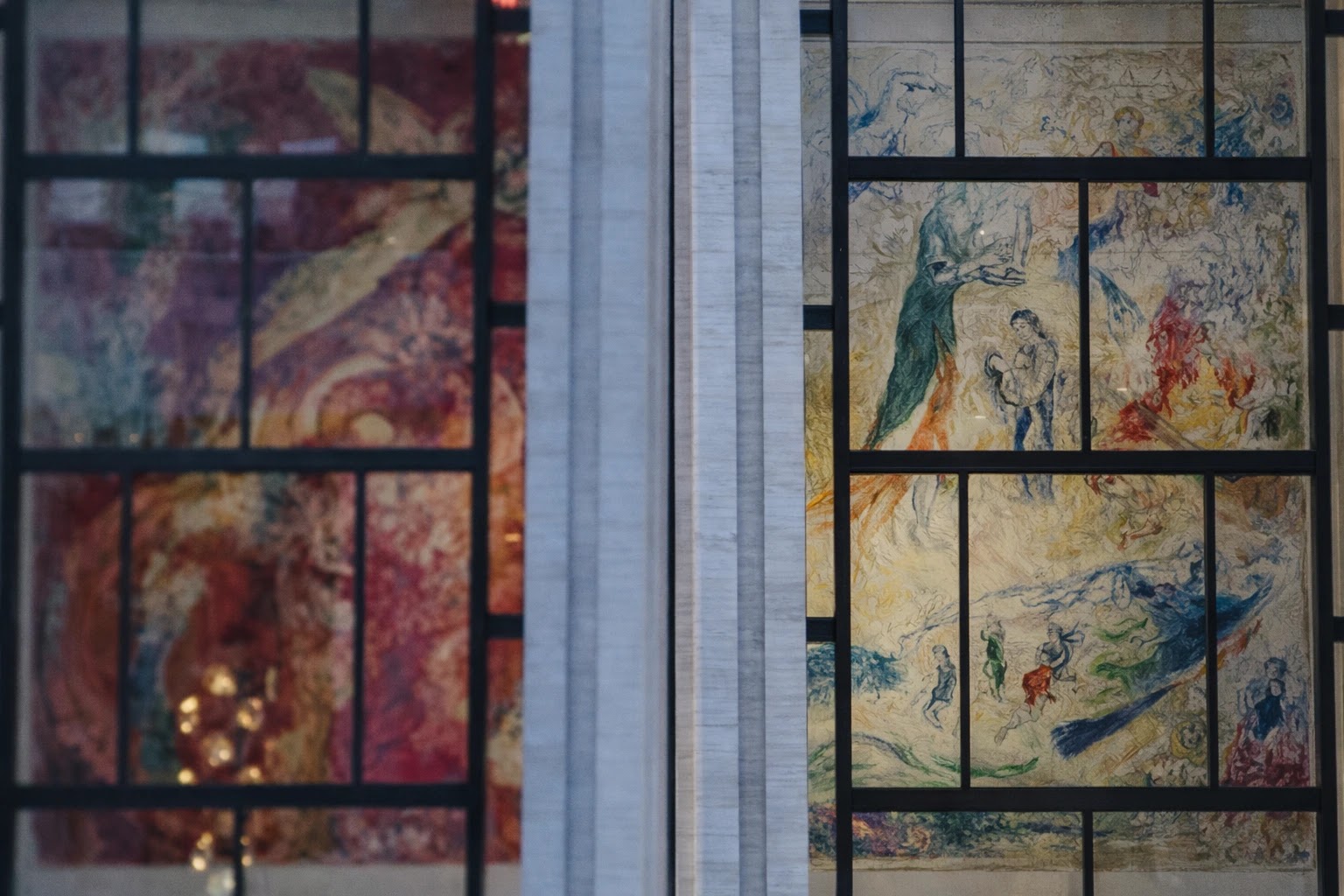

On winter nights at Lincoln Center, the Metropolitan Opera House glows outward, its glass arches revealing Marc Chagall’s murals like theatrical scrims suspended above the lobby.
The Sources of Music and The Triumphs of Music were painted in 1966 to live exactly where they are now unavoidable, architectural, and inseparable from the building’s identity.
As of late January 2026, the Met is actively trying to sell them anyway.
Not in crates. Not at auction. Instead, through a tightly engineered sale-and-leaseback arrangement that would transfer legal ownership of the murals to a private buyer while keeping them permanently bolted to the walls. Sotheby’s has appraised the pair at $55 million, and the Met is now openly searching for what insiders call a “benefactor buyer”, someone willing to own the art without ever removing it.
What looks, on paper, like a clever workaround is in practice a signal flare:
the Met has entered a phase where even its walls are negotiable.
The Silence From Riyadh
The immediate trigger is not artistic ambition or long-term planning, but the eerie silence following a promised $200 million Saudi Arabian subsidy.
Announced in September 2025, the deal was meant to stabilize the Met through 2032. The company would become the resident winter troupe of the new Royal Diriyah Opera House near Riyadh, performing there for several weeks a year beginning in 2028. In return, Saudi Arabia would inject
$200 million into the Met’s finances, money explicitly intended to stop the bleeding of an already battered endowment.
That money has not arrived.
Saudi officials have cited internal budget “recalibrations,” and while General Manager Peter Gelb has insisted the agreement will eventually move forward, the Met had already begun operating as if the funds were real. What remains now is shaky math and an evaporating promise.
The fallout is no longer theoretical. In the past week, the Met has announced:
- 22 administrative layoffs, about 10% of its non-performance staff
- Executive pay cuts ranging from 4% to 15% for 35 senior leaders, including Gelb and Music Director Yannick Nézet-Séguin
- A trimmed season, reduced from 18 productions to 17, with a new staging of Khovanshchina shelved indefinitely
These are not belt-tightening gestures. They are emergency brakes.
When the Lobby Becomes Liquidity
The Chagall murals sit at the intersection of value and vulnerability.
They are monumental roughly 30 by 36 feet each and were conceived specifically for the Met’s architecture. They are also liquid in a way few other assets are. The Met has already tested this once before: in 2009, the murals were quietly pledged as collateral for a $35 million JPMorgan Chase loan.
This time, the institution is going further. Under the current proposal, the buyer would receive full title while agreeing that the works can never be removed. In return, their name would appear nearby
a gold-lettered acknowledgement marking the moment a public treasure became a private tax write-off.
Legally, the Met can do this because it is not a museum. Museums are bound by strict deaccessioning rules that prohibit selling art to cover operating costs. Opera houses are not. That loophole now looms large.
Art lawyers are debating whether the Visual Artists Rights Act (VARA) is implicated when ownership changes hands but the work remains in place. Chagall’s estate retains moral rights over the integrity of the murals, but whether privatizing title in a civic lobby constitutes a distortion of intent is untested ground.
What is not in doubt is the symbolic shift. The murals may not move, but their meaning does.
Numbers That Don’t Sing
Stripped of rhetoric, the crisis looks like this:
| Asset / Liability | Value | Status |
|---|---|---|
| Marc Chagall Murals | $55 million | Proposed sale-and-leaseback |
| Saudi Subsidy | $200 million | “Recalibrating” (delayed) |
| Met Endowment | ~$97.5 million | Down from ~$300M post-Covid |
| Naming Rights (Ask) | $150M–$250M | Under active consideration |
The murals are not the solution. They are a bridge short, expensive, and emotionally charged.
Sting in the Rafters
To generate immediate cash, the Met has also begun renting itself out.
This June, Sting’s musical The Last Ship will occupy the Met stage for a nine-performance run. From a balance-sheet perspective, it makes sense: a Broadway-style musical can clear more net revenue in a week than a repertory opera requiring hundreds of union musicians, chorus members, and stagehands.
From the audience’s perspective, the optics are jarring. The ghost of Pavarotti may soon have to share the rafters with amplified basslines and rock-drums thudding through a space designed for Verdi.
For some, it is harmless pragmatism. For others, it feels like the first audible crack.
If the Walls Aren’t Enough, the Name Is Next
If the Chagall sale does not buy enough time, the Met has already signaled its next move:
selling the name of the building itself.
At Lincoln Center, the path is well worn. Philharmonic Hall became David Geffen Hall.
The New York State Theater became the David H. Koch Theater. The Metropolitan Opera House now stands alone original name intact, price negotiable.
Insiders estimate a naming deal could bring in $150 million to $250 million, enough to permanently recapitalize the endowment. But the reputational calculus is delicate. In philanthropic circles, there is a quiet fear of being remembered less as a savior than as a witness to decline.
“No one wants their name on the plaque that marks the day the Met started selling off its walls,” one donor advisor reportedly said.
A Quiet Moment Before the Downbeat
On a recent afternoon, stagehands could be heard loading equipment through the side doors cases marked not for Wagner or Puccini, but for The Last Ship. Upstairs, the Chagall murals remained exactly where they have always been, their colors floating serenely above the traffic of coats and ticket stubs.
Nothing has changed yet. That may be the most unsettling part.
The murals still greet the audience. The lobby still glows. But the arithmetic behind the beauty has shifted, and everyone walking through the doors can feel it, an institution listening closely, not for applause, but for the next sound it cannot afford to ignore.