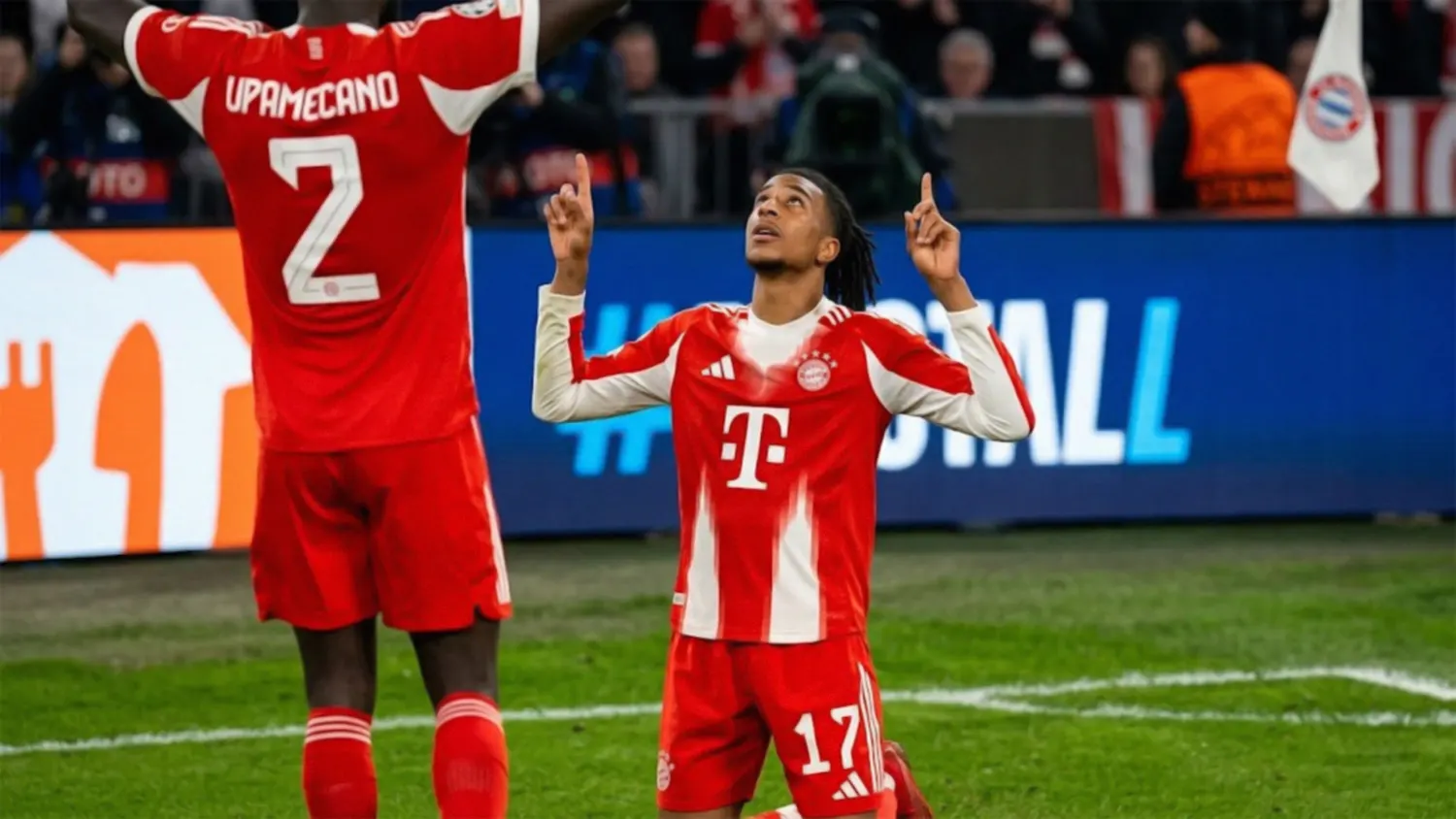
At the Allianz Arena, Bayern Munich delivered a comeback for the ages, defeating Real Madrid 4–3 on the night (6–4 on aggregate) in a quarter final second leg that will be remembered as an instant classic.
For 85 minutes, Madrid appeared to be navigating chaos with trademark composure. But football at this level often hinges on the smallest margins and one moment of indiscipline flipped the entire tie.
A Game That Refused to Settle
The tone was set inside the opening minute. A rare error from Manuel Neuer allowed Arda Güler to pounce, scoring within 35 seconds, the fastest goal in Madrid’s Champions League history. Bayern responded immediately, with Aleksandar Pavlović equalizing from a Joshua Kimmich corner, a reflection of the hosts’ persistent threat from set pieces.
Madrid’s attacking trident continued to stretch Bayern’s defensive line. Arda Güler, drifting into half spaces, restored the lead with a superb free kick before Harry Kane inevitably made it 2–2 with his 50th goal of the season, underlining his role as Bayern’s structural focal point in the final third.
Just before halftime, Kylian Mbappé delivered what felt like a decisive blow, finishing clinically to give Madrid a 3–2 lead on the night. At that point, the tie had the familiar scent of Madrid’s European inevitability.
The Decisive Moment
Everything changed in the 86th minute. With the aggregate score finely balanced, Eduardo Camavinga received a second yellow card, a dismissal that completely altered the tactical landscape.
Reduced to ten men, Madrid were forced into a low defensive block, abandoning their transitional threat. Bayern, sensing vulnerability, pushed aggressively into advanced areas, overloading the flanks and half spaces.
Within three minutes, the breakthrough arrived. Luis Díaz drove into space and fired home the 89th minute equalizer, a goal that shifted the aggregate in Bayern’s favor. Then, deep into stoppage time, Michael Olise exploited Madrid’s stretched defensive shape to score the 90+4′ winner, completing a stunning turnaround.
Tactical Battle: Width vs. Control
The match evolved into a classic clash of structural philosophies. Bayern’s approach emphasized width and vertical progression, particularly through wide forwards like Luis Díaz and Michael Olise, who consistently attacked Madrid’s full-backs.
Madrid, by contrast, relied on fluid positional rotations, with Arda Güler and Kylian Mbappé exploiting transitional moments. However, once reduced to ten men, their compactness came at the cost of offensive outlet effectively inviting Bayern to sustain pressure.
The numerical disadvantage exposed Madrid’s inability to maintain midfield control, an area where Joshua Kimmich began dictating tempo with increasing authority late in the match.
Standout Performances
Harry Kane once again delivered on the biggest stage, not only scoring but serving as the central reference point for Bayern’s attacking structure.
Luis Díaz and Michael Olise proved decisive, their late goals reflecting both composure and tactical awareness in high pressure moments.
For Madrid, Arda Güler was exceptional, combining technical quality with attacking intelligence, while Kylian Mbappé remained a constant threat, finishing clinically despite the eventual collapse.
Implications: Bayern Surge, Madrid Falter
For Bayern Munich, this victory reinforces their status as genuine contenders. Momentum is firmly on their side heading into a heavyweight semi final against Paris Saint-Germain, a rematch loaded with narrative and elite attacking talent.
For Real Madrid, the defeat is deeply significant. Combined with their domestic struggles, this elimination raises serious questions about squad balance and game management in critical moments.
PSG End Liverpool’s Hopes with Ruthless Efficiency
At Anfield, Paris Saint-Germain delivered a performance defined by control and clinical execution, defeating Liverpool 2–0 (4–0 aggregate) to book their place in the semi finals.
Despite the atmosphere and history of comebacks, Liverpool never truly destabilized PSG’s structure.
Control Over Chaos
Liverpool began with intensity, pressing high and forcing moments of discomfort. But PSG’s composure in possession and their willingness to absorb pressure proved decisive.
A key moment came when a penalty initially awarded to Liverpool was overturned by VAR, halting the home side’s momentum. From that point, PSG reasserted control.
The Decisive Moment
The breakthrough arrived in the 72nd minute. Ousmane Dembélé, the standout performer, curled in a superb strike from the edge of the box, a goal that effectively ended the tie.
He then sealed the result in stoppage time with a second goal on the counter, punishing Liverpool’s increasingly desperate attacking shape.
Tactical Superiority
Under Luis Enrique, PSG displayed remarkable discipline. Their mid block limited central penetration, forcing Liverpool wide and into predictable crossing patterns comfortably handled by Marquinhos and company.
In transition, PSG were lethal. The pace and directness of Ousmane Dembélé exposed Liverpool’s defensive line, particularly as the game stretched in the latter stages.
Standout Performances
Ousmane Dembélé was the clear difference maker, scoring both goals and consistently threatening in transition.
Marquinhos produced a defining defensive moment with a crucial goal line clearance, preserving PSG’s aggregate advantage at a critical stage.
Implications: A Statement of Intent
For Paris Saint-Germain, this was more than progression, it was a statement. Their blend of tactical discipline and attacking efficiency positions them as strong favorites heading into the semi finals.
Liverpool, meanwhile, are left to reflect on missed opportunities and the growing gap between domestic competitiveness and European elite control.
The Road to Budapest
The semi final lineup now promises two compelling narratives:
- Paris Saint-Germain vs. Bayern Munich — a clash of elite attacking systems and a rematch rich in history.
- Atlético Madrid vs. Arsenal — a stylistic duel between structured defensive resilience and positional fluidity.
With players like Kylian Mbappé, Harry Kane, and Khvicha Kvaratskhelia dominating the scoring charts, the tournament is entering its most decisive phase.
The margins are finer, the stakes higher and if these quarter finals are any indication, the road to Budapest will be anything but predictable.