
When Currency Moves, Daily Life Moves With It
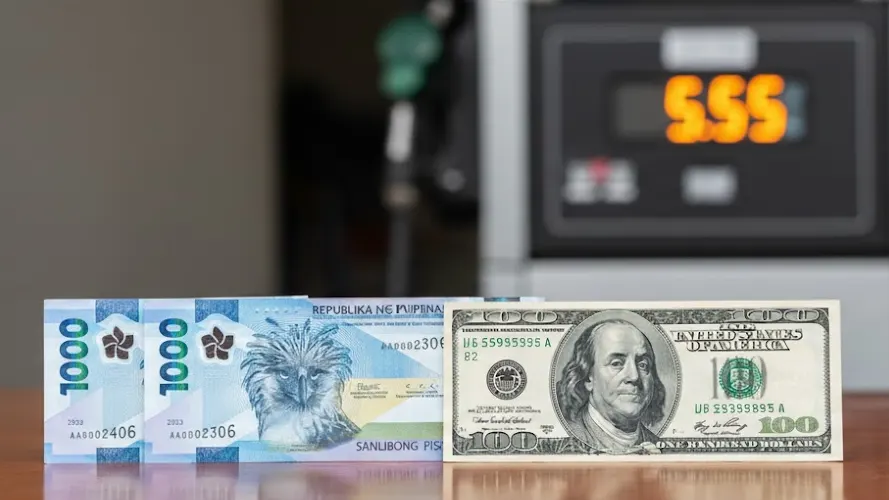
The Philippine peso closed the trading week at ₱59.00 per US dollar,
its weakest level in more than a month and a number that economists
are watching closely.
At first glance, a currency move might seem like the kind of thing that only traders care about. But exchange rates rarely stay confined to financial charts. They eventually show up in places people notice, the price of diesel, airline tickets, grocery bills, and even the money families receive from relatives overseas.
The peso’s decline is happening at a moment of rising geopolitical tension and energy uncertainty. Together, those forces are creating a powerful global shift that is pushing money toward the US dollar and away from emerging markets like the Philippines.
Understanding what is happening requires looking beyond the currency chart and into the broader forces shaping global markets.
A Global Shift Toward Safety
Currency markets tend to react quickly when geopolitical risks rise.
In uncertain times, investors usually retreat from riskier assets and move their money into safe havens.
Economists describe this phenomenon as risk off sentiment.
The escalating conflict in the Middle East particularly tensions involving
a U.S.–Israeli coalition and Iran has intensified that reaction.
Investors are buying US dollars and gold, both considered safe assets during periods of instability.
As demand for the dollar rises worldwide, the exchange rate shifts. Emerging market currencies from the Philippine peso to the Indonesian rupiah begin to weaken because global investors are pulling funds out of those markets.
But geopolitics isn’t the only factor pushing currencies lower.
Energy markets are adding another layer of pressure.
Oil Prices and the Philippines’ Energy Exposure
The Philippines relies heavily on imported fuel. That makes the economy particularly sensitive to swings in global oil prices.
With Brent crude hovering around $80 per barrel and analysts warning that prices could climb toward $100 if Middle East tensions disrupt supply routes, markets are already bracing for higher energy costs.
When oil prices rise, transportation, logistics, and manufacturing costs follow. Analysts are already projecting that diesel prices in the Philippines could jump by as much as ₱20 per liter in the coming week if the trend continues.
This situation becomes even more challenging when combined with a weakening currency. Together, they create what economists call imported inflation.
How a Weak Peso Fuels Imported Inflation
Most global commodities oil, wheat, metals are priced in US dollars.
That means countries like the Philippines must convert pesos into
dollars before purchasing them.
When the peso weakens, that conversion suddenly becomes more expensive.
Consider a simple example:
- Oil price: $80 per barrel
- At ₱56 per dollar, that equals ₱4,480 per barrel
- At ₱59 per dollar, the same barrel costs ₱4,720
The oil didn’t change. But the weaker currency makes it more expensive locally.
Multiply that difference across millions of barrels of imports and the impact quickly spreads through the economy. Transport companies face higher fuel bills, logistics costs climb, and businesses eventually pass those expenses to consumers.
That chain reaction is the essence of imported inflation, a global price that becomes more expensive simply because the local currency has weakened.
The Real World Ripple Effects
The currency move is already starting to show up across different sectors of the Philippine economy.
The Philippine Stock Exchange index (PSEi) fell nearly 1% on Friday, closing at 6,320.41, with financial and service companies leading the decline as investors turned cautious.
Airlines are also feeling the impact. Philippine Airlines and several regional carriers have begun canceling flights to Doha, Riyadh, and Dubai as security concerns in the Middle East escalate.
Fuel costs, aviation routes, and equity markets may seem unrelated,
but they are all reacting to the same underlying forces: geopolitical risk, energy prices, and global capital flows.
Yet currency depreciation doesn’t affect everyone the same way.
Who Wins and Who Loses from a Weak Peso
For many consumers, a weaker currency means higher prices for imported goods and overseas travel.
If a year ago it took about ₱56 to buy one dollar, today it requires ₱59. That means international purchases from electronics to online subscriptions cost more in local currency terms.
But depreciation also creates winners.
Families of overseas Filipino workers benefit immediately. If a relative sends home $1,000, the household now receives ₱59,000 instead of around ₱56,000 just months earlier.
Export oriented industries see similar advantages. Filipino companies selling services abroad especially the business process outsourcing sector become more competitive because their services effectively become cheaper for foreign clients.
In other words, currency shifts redistribute economic benefits across different groups.
Southeast Asia’s Currency Pressure
The peso’s weakness is part of a broader regional trend.
Across Southeast Asia, currencies are facing pressure as investors shift funds into dollar denominated assets.
Regional Currency Snapshot (March 7, 2026)
| Currency | Approx. Level vs USD | Market Sentiment |
|---|---|---|
| Indonesian Rupiah | Rp 16,892 | Heavy pressure; central bank intervening |
| Malaysian Ringgit | RM 3.94–3.98 | Weakening despite oil exports |
| Thai Baht | ฿35.8–36.1 | Vulnerable due to fuel costs and tourism risk |
| Singapore Dollar | S$1.34–1.35 | Relatively stable; regional safe haven |
| Vietnamese Dong | ₫25,400 | Near record lows |
Investors are also pulling money out of regional equity markets and into US Treasury bonds, where yields remain attractive.
This capital shift is leaving many central banks in Southeast Asia facing a difficult policy choice.
Visualizing the Central Bank Dilemma
When currencies weaken and inflation rises, central banks must decide how to respond. The challenge is that every option carries consequences.
This policy trade off is known as the central bank dilemma.
Option 1: Let the Currency Weaken
Advantages
- Interest rates remain low
- Borrowing stays affordable
- Economic growth continues
Risks
- Currency depreciation worsens
- Imported goods become more expensive
- Inflation accelerates
Option 2: Raise Interest Rates
Advantages
- Higher rates attract foreign investment
- The currency stabilizes
- Inflation pressures ease
Risks
- Loans become more expensive
- Business investment slows
- Economic growth weakens
For policymakers, it often becomes a choice between higher inflation today or slower economic growth tomorrow.
The Bangko Sentral ng Pilipinas has signaled that while the current exchange rate is still manageable, it is prepared to raise interest rates
if the dollar rally intensifies or oil prices surge further.
The Data That Could Decide the Next Move
The next major test for currency markets will arrive not from Southeast Asia but from the United States.
Investors are closely watching the upcoming US Consumer Price Index (CPI) report, which measures inflation across the American economy.
Economists are particularly concerned about sticky inflation,
price increases that refuse to slow down despite previous rate hikes.
If US inflation remains stubbornly high, the Federal Reserve may keep interest rates elevated for longer.
That matters because higher US interest rates act like a magnet for global capital. Investors shift money into US Treasury bonds for safer returns, strengthening the dollar even further.
For emerging markets, this creates what analysts often call the dollar gravity effect: capital flows toward the United States while currencies elsewhere weaken.
If CPI data comes in hotter than expected, analysts warn that regional currencies could test new psychological thresholds including ₱60 per dollar for the Philippine peso and Rp17,000 for the Indonesian rupiah.
What to Watch in the Coming Week
Markets will be paying close attention to several signals:
- US inflation data, which could shape the Federal Reserve’s rate outlook
- Global oil prices, particularly if Brent approaches $100 per barrel
- Central bank responses from the Philippines and Indonesia
- Investor flows into US Treasury bonds and emerging market equities
Each of these factors will help determine whether the peso stabilizes or continues sliding toward new lows.
A Currency Story That Touches Everyday Life
Exchange rates may seem like abstract financial numbers, but their effects are anything but abstract.
They influence fuel costs, transportation prices, overseas remittances, airline routes, and business investment decisions. In short, they shape how money moves through an economy.
The peso’s move toward ₱59 is a reminder that global events from geopolitical tensions to inflation data in the United States can quickly ripple through local markets.
Whether the currency stabilizes or pushes toward the ₱60 threshold will depend largely on forces far beyond the Philippines’ borders.
For now, the message from global markets is clear: in an interconnected financial system, the value of a currency is often a reflection not just of domestic conditions, but of the shifting tides of the world economy.