
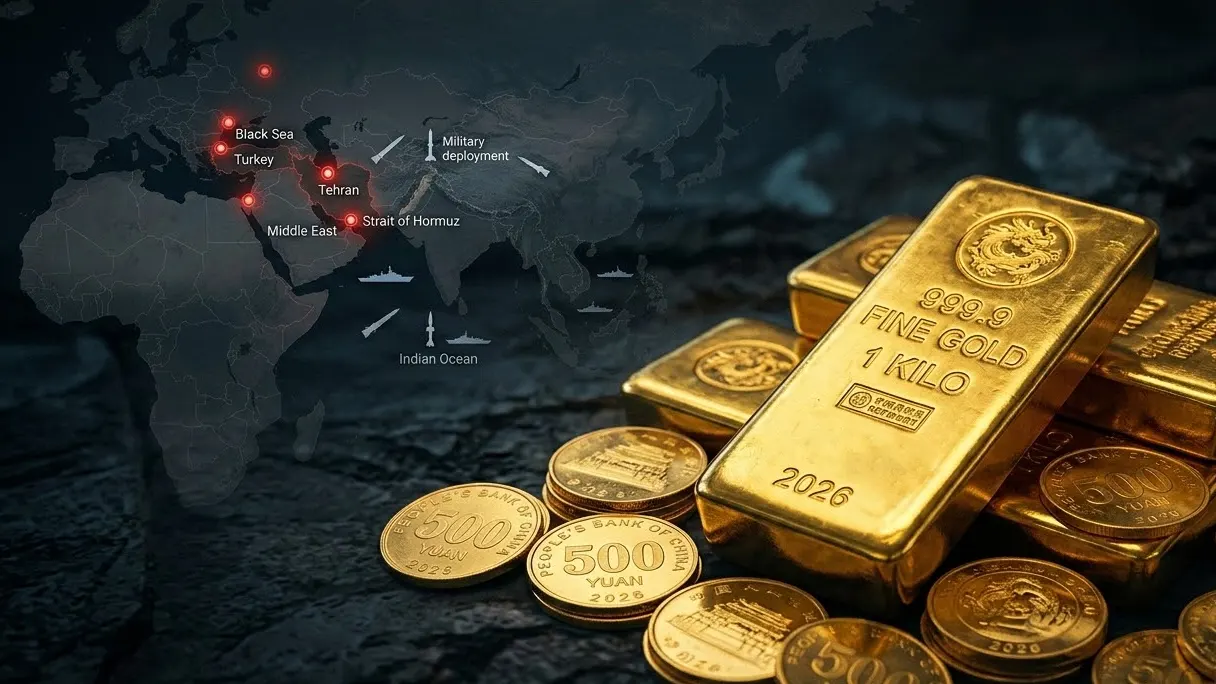
Gold is no longer just a luxury or an investment, it’s a mirror of global tension. On March 5, 2026, Gold is acting as a “pressure gauge” for escalating conflicts in the Middle East, showing exactly how geopolitical risks ripple through markets worldwide.
Gold Holds Its Ground Amid Geopolitical Tensions
As of this afternoon, gold is steady around $5,160 – $5,185 per ounce, bouncing back after a slight dip earlier in the day. Prices briefly touched $5,200 before traders took profits, reflecting the classic tug of war between optimism and caution.
The main driver of today’s rally ? Escalating naval and air conflicts in the Middle East. Investors are fleeing high growth tech stocks and moving into bullion, seeking safety as uncertainty spikes.
Why Demand for Gold is Surging
Several forces are converging to push gold higher:
- War Premium: With US-Israel forces and Iran actively engaged, the risk of the conflict spreading regionally is at its highest in six days.
- Inflation Hedge: Brent crude prices have surged toward $84 per barrel, raising concerns about broader inflation. Gold remains the traditional hedge against a devaluing currency.
- $5,000 “Floor”: Technical analysts view $5,000 as a critical support level. Central banks and long term funds have aggressively defended this price even after a recent 5% sell off.
Domestic prices are reflecting these global tensions:
- India: 24K gold trades near ₹1,64,660 per 10 grams, down slightly from ₹1.73 lakh.
- USA: April gold futures are around $5,186 per ounce, slightly higher than spot.
The Binary Market: Escalation vs. Ceasefire
The gold market is currently “pricing in” two stark possibilities:
The Escalation Path ($5,600+)
- NATO Trigger: The interception of an Iranian missile over Turkey could spark consultations under NATO Articles 4 or 5, sending investors scrambling for gold.
- Strait of Hormuz: The sinking of the IRIS Dena yesterday raises the risk of a full blockade, potentially pushing oil above $100/barrel.
A surge in energy prices would make gold the go to hedge, driving it toward $5,600–$6,000.
The Ceasefire Correction ($4,800)
- Speculative Flush: Roughly $400–$500 of gold’s current price reflects the “war premium.” Any diplomatic breakthrough would trigger a swift sell off.
- Technical Support: The 50 day moving average clusters around $4,814, meaning a drop to $4,800 could attract “buy the dip” investors without breaking the long term bullish trend.
Even in a ceasefire scenario, many analysts insist that gold is unlikely to stay below $5,000 for long because central banks are reducing reliance on the US dollar, cementing gold’s role as a structural pivot in global finance.
Gold vs. Other Assets
| Asset | Current Status | Sentiment |
|---|---|---|
| Gold (XAU) | $5,179 | Strong Safe Haven |
| Silver (XAG) | $84.72 | High Volatility, Industrial Lag |
While gold acts as the “shield,” silver is currently struggling with
a “war time industrial lag,” as military driven supply chain disruptions hamper its use in solar panels, electronics, and other industrial applications. This divergence reinforces gold’s role as the safe haven centerpiece during geopolitical turbulence.
China: The Global Gold Whale
China’s buying strategy has become a major stabilizing force in global markets. While retail demand is soft due to high prices, the People’s Bank of China (PBOC) and institutional investors are doubling down.
- 15 Month Buying Streak: China’s central bank has added gold for 15 consecutive months.
- Current Holdings: Official reserves now stand at 74.19 million troy ounces (~2,308 tonnes), valued at $369.6 billion. Analysts estimate the true total including unofficial accounts may exceed 5,000 tonnes.
- Shift from Jewelry to Bars: Domestic investors are favoring gold bars and coins over jewelry, with ETF assets reaching $36 billion, while physical jewelry consumption falls.
- Strategic Reasons: China is reducing exposure to US debt, backing its financial system with a hard asset, and expanding gold storage internationally to challenge London and New York dominance.
India: Steady Accumulator
India’s approach contrasts with China’s stealth strategy.
- Reserve Bank of India: Official gold holdings are climbing toward 880 tonnes, offering stability for the Rupee.
- Investor Behavior: 54% of Indian consumers plan to increase gold holdings in 2026, shifting toward liquid, digital gold ETFs.
- Price Support: Strong domestic demand from weddings and festivals keeps prices around ₹1,64,000 per 10 grams.
Russia: The Emergency Seller
Russia is taking a rarely seen approach selling gold instead of accumulating it.
- Liquidity Needs: Heavy financial pressure from the Ukraine conflict and sanctions has forced the sale of nearly 71% of its National Wealth Fund gold since 2022.
- China Pivot: Russia exports a large portion of this gold directly to China, effectively monetizing reserves to fund urgent needs.
BRICS and the “Unit” Pilot
Other BRICS members, like Brazil, are cautiously increasing reserves. Meanwhile, the expanded BRICS+ bloc including Egypt, Iran,
and the UAE is piloting a gold anchored trade tool called the “Unit.”
Update: The BRICS+ “Unit” pilot, launched in January 2026, is currently being tested by 11 nations. It is anchored 40% by physical gold, meaning every successful trade within this system creates a permanent, structural demand for the metal that didn’t exist a year ago. This initiative underscores a broader shift toward gold backed financial sovereignty
and a potential reduction in dependence on the US dollar and SWIFT system.
BRICS Gold Snapshot (March 2026):
| Country | Total Reserves | March 2026 Momentum |
|---|---|---|
| China | 2,308+ Tonnes | Aggressive (Strategic) |
| Russia | 2,336 Tonnes | Selling (Liquidity/War) |
| India | 880 Tonnes | Steady (Institutional) |
| Brazil | 145 Tonnes | Emerging Buyer |
Key Insight: China buys for geopolitical dominance, India for financial stability, and Russia for emergency liquidity. Together, BRICS controls nearly 70% of global gold reserves, a major shift from the Western led markets of the past decade.
Key Takeaways
- Gold is the ultimate safe haven, reacting directly to geopolitical risks and energy price spikes.
- Markets are binary: Prices could surge above $5,600 if conflict escalates, or retreat to $4,800 in a ceasefire scenario.
- China, India, and Russia are shaping the global gold landscape with different strategies, collectively controlling a majority of reserves.
- The BRICS+ “Unit” system is creating permanent structural demand for gold, signaling a potential long term shift in global trade settlements.
- Investors should watch for technical floors, geopolitical triggers, and central bank activity, as these factors will determine the next moves in the gold market.
gold is no longer just a commodity, it is a global thermometer, measuring the heat of conflict, economic uncertainty, and geopolitical strategy all at once.