The UEFA Champions League Round of 16 concluded with a barrage of goals, statement victories, and the emergence of clear contenders for the crown in Budapest. Across Europe, elite sides flexed their attacking muscle, but beneath the scorelines lay deeper tactical narratives pressing structures, transitional ruthlessness, and individual brilliance shaping the path forward.
Barcelona 7–2 Newcastle (8–3 agg.) — A Relentless Blaugrana Machine
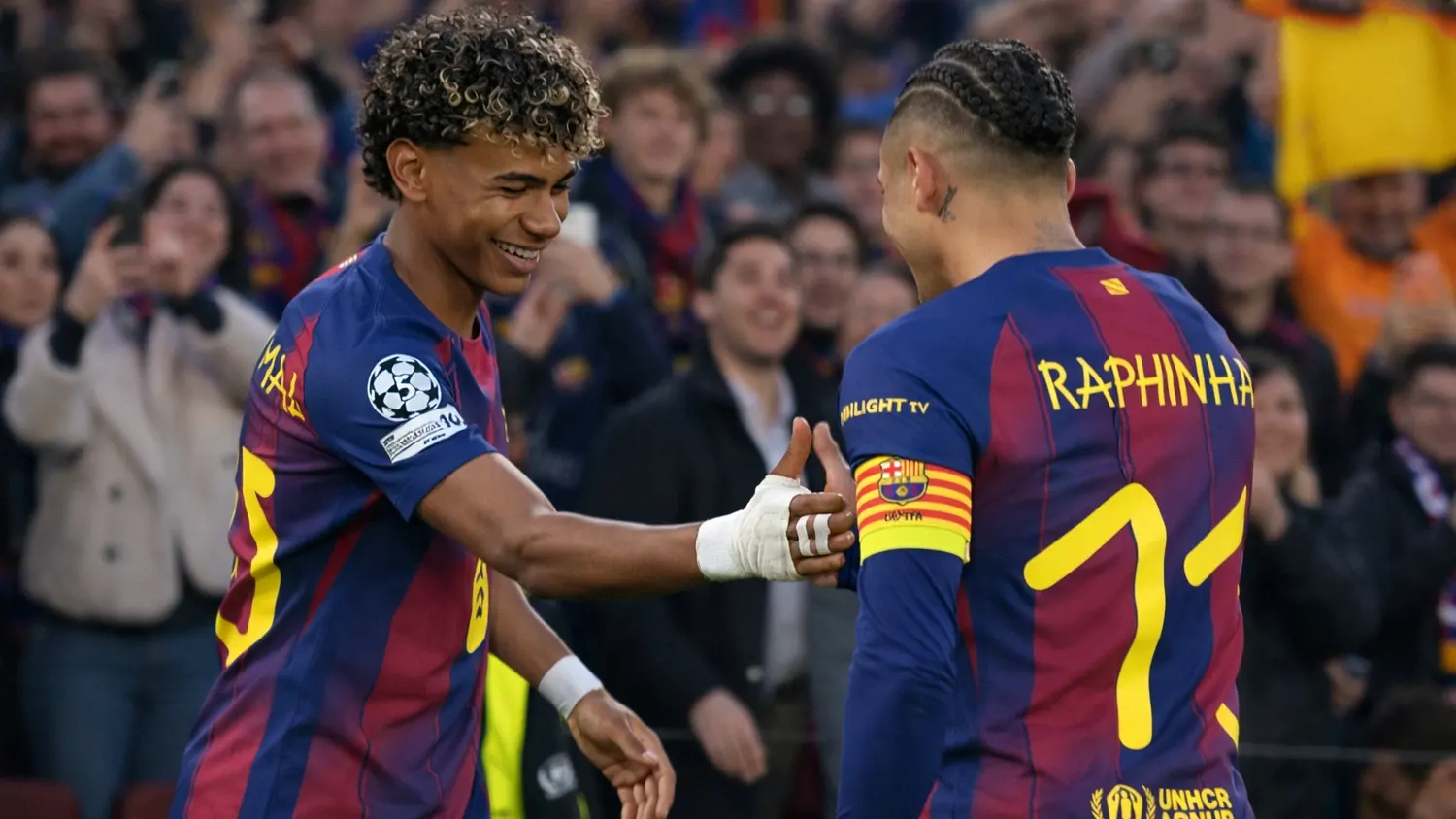
At the Spotify Camp Nou, Barcelona delivered one of the most devastating attacking performances of the season, dismantling Newcastle United in a tie that briefly teased competitiveness before spiraling out of control.
The decisive moment arrived just before halftime. With Barcelona already leading,
Lamine Yamal calmly converted a penalty to make it 4–2, extinguishing Newcastle’s resistance after a chaotic opening half hour.
Early on, Raphinha set the tone with a goal inside six minutes, exploiting space behind Newcastle’s high defensive line. Yet, the visitors responded admirably through Anthony Elanga, whose brace briefly exposed Barcelona’s transitional vulnerabilities.
Tactically, however, Barcelona’s superiority became overwhelming. Their high press coordinated and relentless forced repeated turnovers in midfield. Once Newcastle’s structure began to collapse, the spaces between lines became unmanageable.
The second half belonged to Robert Lewandowski, whose quick fire brace (56’, 61’) killed the tie outright. His movement between center backs and clinical finishing underscored Barcelona’s attacking efficiency.
In truth, this was more than a win, it was a declaration. Barcelona are no longer rebuilding; they are imposing.
Liverpool 4–0 Galatasaray (4–1 agg.) — Anfield’s Second Half Storm
At Anfield, Liverpool FC produced a classic European comeback, overwhelming Galatasaray with intensity, volume, and precision.
The turning point came early in the second half, a devastating 17 minute spell that transformed tension into inevitability.
After a cagey start, Dominik Szoboszlai brought Liverpool level on aggregate with a composed goal in the 25th minute, setting the stage for what followed.
Interestingly, the first half also featured a rare blemish: Mohamed Salah missing a Panenka penalty. Yet, his response defined the night. He later produced a sublime curling goal, marking his 50th in the competition, a moment of both redemption and elite pedigree.
From a tactical perspective, Liverpool’s approach was clear: relentless shot volume
(32 attempts) and aggressive counter pressing. Galatasaray struggled to play through the first line, repeatedly conceding possession in dangerous zones.
The knockout blow came through Hugo Ekitike and Ryan Gravenberch, who scored in quick succession to put the tie beyond doubt.
This was Liverpool at their most ruthless chaotic, vertical, and devastating in bursts.
Bayern Munich 4–1 Atalanta (10–2 agg.) — The Bavarian Machine Rolls On
If there were any doubts about Bayern Munich, they were emphatically erased in Munich. A 10–2 aggregate demolition of Atalanta BC highlighted not just attacking power, but systemic dominance.
The defining narrative was Harry Kane, who scored a brace and reached the milestone of 50 Champions League goals in just 66 appearances, an extraordinary rate.
Even without key figures, Bayern’s structure remained intact. Their positional play fluid yet disciplined allowed them to overload wide areas before cutting centrally with precision.
A standout subplot was teenage talent Lennart Karl, whose goal and assist (for Luis Díaz) illustrated Bayern’s depth and future promise.
Atalanta’s late goal from Lazar Samardžić was little more than consolation. Over two legs, the Italians were systematically dismantled.
Bayern now look like a fully calibrated machine efficient, ruthless, and peaking at the right time.
Tottenham 3–2 Atlético Madrid (5–7 agg.) — A Victory Without Reward
In North London, Tottenham Hotspur produced a spirited performance, defeating Atlético Madrid on the night but falling short where it mattered: the aggregate score.
The decisive moment in the tie, however, came not in London but in the first leg, where Spurs’ defensive collapse left them chasing an insurmountable deficit.
Still, this second leg had its own drama. Randal Kolo Muani opened the scoring with a powerful header, setting the tone for a chaotic contest.
Each time Spurs surged ahead, Atlético responded embodying the resilience synonymous with Diego Simeone’s philosophy.
The standout figure was Julián Álvarez, who not only scored but also assisted Dávid Hancko’s crucial goal, effectively sealing the tie.
For Spurs, Xavi Simons delivered a heroic display, scoring a stunning long range goal and converting a late penalty. Yet, it wasn’t enough.
This was a match and a tie that perfectly encapsulated Atlético’s identity: bend, absorb, and strike when it matters most.
Implications: A Tournament Taking Shape
As the competition moves into the quarterfinals, the landscape is sharply defined.
The attacking explosions from Barcelona, Liverpool, and Bayern Munich signal a shift toward high intensity, high output football among Europe’s elite. Meanwhile, Atlético Madrid remain the outlier, a side capable of surviving chaos through discipline and experience.
At the individual level, the Golden Boot race adds another layer of intrigue. Kylian Mbappé leads the charge, but Harry Kane and Julián Álvarez are closing in, while emerging stars like Lamine Yamal continue to disrupt expectations.
With heavyweight clashes like Real Madrid vs. Bayern Munich and Paris Saint-Germain vs. Liverpool looming, the margins will only tighten.
The Round of 16 delivered spectacle. The quarterfinals promise something even greater: definition.