
The Milano Cortina 2026 Winter Olympics are officially in full swing, and Day 2 (Sunday, February 8, 2026) delivered a masterclass in high stakes competition. From the icy slopes of the Italian Alps to the precision focused rinks of Milan, the second day of the Games was defined by a mixture of veteran resilience, record-breaking speed, and the crushing unpredictability of elite sports.
As the sun sets on day two, the host nation, Italy, has surged to the top of the total medal count, while the United States and Norway have staked their claims in the gold medal column. Here is your definitive guide to the highlights, heartbreak, and historic milestones of Day 2.
The “Azzurri” Surge: Italy Dominates the Total Medal Count
Home field advantage is a powerful force in the Olympics, and the Italian team is proving it. By the end of Day 2, Italy leads the world with 9 total medals. While they currently hold only one Gold, their consistency in securing Silver and Bronze across disciplines like Figure Skating and Speed Skating has sent the local crowds into a frenzy.
The highlight for the host nation was undoubtedly the Bronze medal in the Figure Skating Team Event. This marks the first time in Olympic history that Italy has stood on the podium for this specific event, signaling a new era for Italian winter sports.
Current Medal Table (Top 5)
| Rank | Nation | 🥇 Gold | 🥈 Silver | 🥉 Bronze | Total |
| 1 | Italy | 1 | 2 | 6 | 9 |
| 2 | Norway | 3 | 1 | 2 | 6 |
| 3 | Japan | 1 | 2 | 1 | 4 |
| 4 | Austria | 1 | 2 | 0 | 3 |
| 5 | Germany | 1 | 1 | 1 | 3 |
Figure Skating: The “Quad God” Delivers Gold for USA
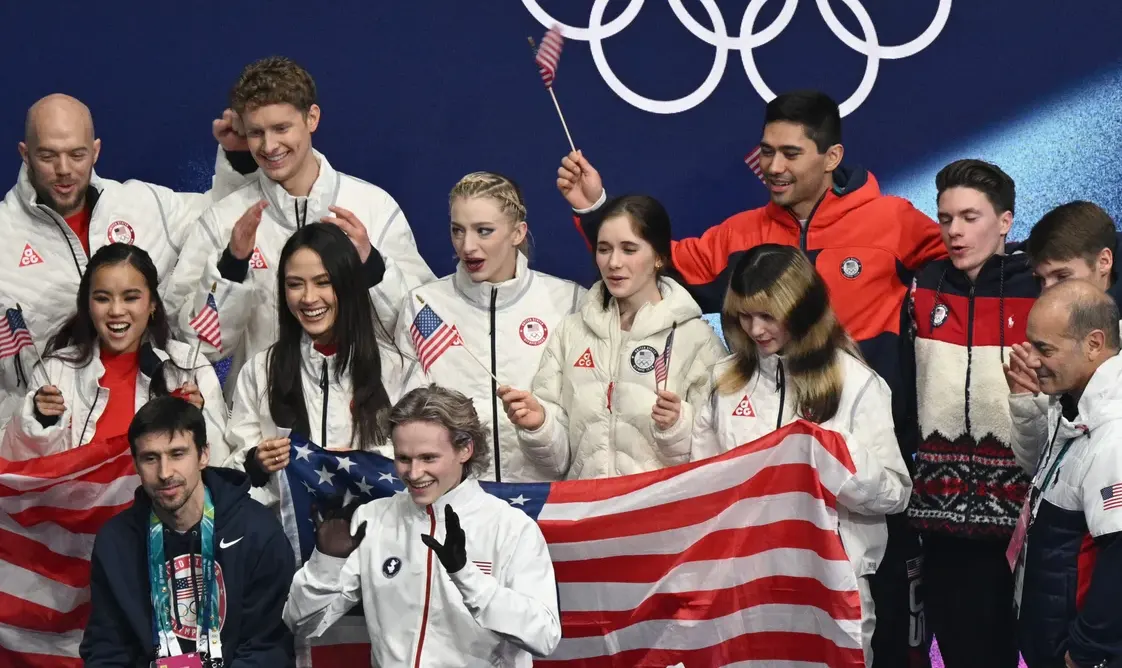
The marquee event of the morning was the conclusion of the Figure Skating Team Event. All eyes were on Ilia Malinin, the 21-year old American sensation known globally as the “Quad God.”
Malinin did not disappoint. In a free skate that will be studied for years, he landed five quadruple jumps, including a flawlessly executed Quad Axel, a jump so difficult it was once thought impossible. His technical score propelled Team USA to the top of the podium with a final score of 69 points.
The battle for Silver was a nail biter between Japan and Italy. Japan’s Shun Sato delivered a poetic performance, but it wasn’t enough to catch the Americans, leaving Japan with a well-deserved Silver (68 points). Italy’s Bronze win (61 points) was the emotional peak of the day at the Mediolanum Forum.
Alpine Skiing: Glory for Johnson, Tragedy for Vonn
The Women’s Downhill in Cortina d’Ampezzo was a tale of two very different outcomes for the American team.
Breezy Johnson finally captured the Olympic Gold that has eluded her throughout her injury plagued career. She navigated the “Tofane” course with aggressive precision, clocking a time that beat Germany’s Emma Aicher by a razor thin margin of 0.04 seconds.
However, the celebration was tempered by a harrowing moment involving skiing legend Lindsey Vonn. The 41 year old, who came out of retirement for one final Olympic run, lost her edge on a high speed turn and crashed violently into the safety netting. The race was paused for 20 minutes as Vonn was airlifted to a nearby hospital. Early reports from the US Ski Team confirm she has undergone successful surgery for a broken leg and is expected to make a full recovery, though her competitive career is likely over.
Norway’s Mastery: Records Fall in Speed Skating
While Italy has the quantity, Norway is leading in quality. The Scandinavian powerhouse added two more Golds to their tally on Day 2, largely thanks to their dominance in endurance sports.
In the Men’s 5000m Speed Skating, Sander Eitrem delivered one of the most clinical performances in Olympic history. Skating in the final pair, Eitrem maintained a consistent lap pace that saw him cross the line at 6:03.95, shattering the previous Olympic record.
Meanwhile, on the cross country tracks, Johannes Høsflot Klæbo won the Men’s Skiathlon. This victory marks Klæbo’s 6th career Olympic Gold medal, further cementing his legacy as the greatest cross country skier of the modern era.
Snowboarding: The Ageless Benjamin Karl
In the Parallel Giant Slalom, age proved to be nothing but a number. Benjamin Karl of Austria, at 40 years old, became the oldest individual Gold medalist in the history of the Winter Olympics. Karl’s veteran experience allowed him to navigate the softening afternoon snow better than his younger competitors, defeating Slovenia’s Tim Mastnak in the big final.
On the women’s side, the “Snow Queen” Ester Ledecká was upset in the quarterfinals, opening the door for Zuzana Maderová (Czechia) to take home her first Olympic Gold.
Curling: Mixed Doubles Update
In the round robin stages of Mixed Doubles Curling, Great Britain has emerged as the team to beat. With an 8-1 record, the duo of Mouat and Dodds have officially qualified for the semifinals.
The United States (6-2) also secured their spot in the knockout round after a decisive victory over China. The battle for the final two semifinal spots remains open between Sweden, Norway, and Canada.
Looking Ahead: What to Watch on Day 3
As we move into Monday, February 9, the excitement only intensifies. Here are the key events you won’t want to miss:
- Men’s Alpine Skiing (Combined): Can the Swiss favorites hold off the hard charging Austrians?
- Short Track Speed Skating: The Men’s 1500m final is expected to be a chaotic, high-speed showdown between South Korea and China.
- Women’s Ice Hockey: A massive group-stage clash between the USA and Canada, a preview of the likely Gold medal game.
The 2026 Winter Olympics are proving to be a spectacle of resilience and national pride. Stay tuned for daily updates as we track the quest for Gold in Milano Cortina.