
An Olympics That Refused to Start Quietly
The Milano Cortina 2026 Winter Olympics didn’t just begin tonight, they erupted across Italy in a blaze of music, symbolism, and competitive drama that already feels unmistakably Olympic.
From a roaring San Siro Stadium in Milan to the snow draped peaks of Cortina d’Ampezzo, these Games opened with a bold message: this is not a single city Olympics.
It’s a nationwide performance staged between steel and stone, fashion capital and mountain frontier, history and high speed sport.
And before the fireworks even faded, the competition had already delivered twists worthy of a final weekend.
A Ceremony Split Between Worlds
The Opening Ceremony, titled “Armonia” (Harmony), is built on contrast urban energy meeting alpine stillness.
At Milan’s iconic San Siro, global spectacle took center stage. Mariah Carey stunned the crowd with a performance in Italian, a moment engineered for mass sing along unity.
Andrea Bocelli brought operatic gravitas, Laura Pausini delivered Italian pop power, and White Lotus star Sabrina Impacciatore stepped into the theatrical segment exploring nature, invention, and Leonardo da Vinci’s legacy.
But the defining image of the night wasn’t just on stage.
The First-Ever Twin Olympic Cauldrons
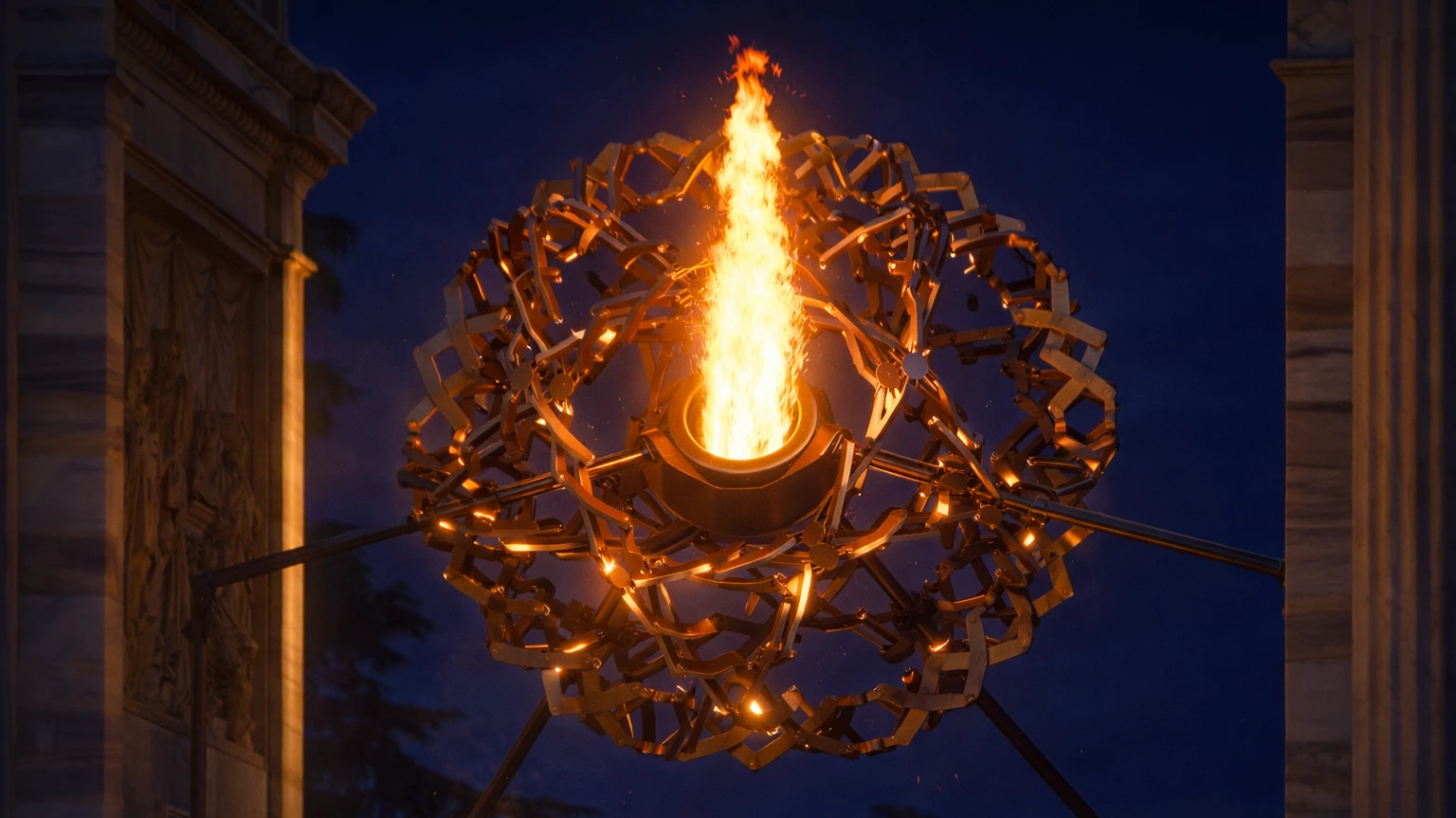
In an Olympic first, two identical cauldrons were lit simultaneously
one at Milan’s Arco della Pace, the other in Cortina d’Ampezzo.
Inspired by Leonardo da Vinci’s geometric “knots,” the cauldrons are constructed from lightweight aeronautical aluminum and designed to pulse like a heartbeat, a living visual metaphor for the Games’ “Harmony” theme.
Organizers also emphasized sustainability: the flames use low-smoke, low-noise scenic effects to reduce environmental and acoustic impact.
It wasn’t just symbolism. It was engineering turned into storytelling.
A Parade Without Borders
Athletes didn’t march into one stadium. Instead, parades unfolded in four locations Milan, Cortina, Livigno, and Predazzo.
Giant screens linked the celebrations, while Milan audiences watched live check ins from competitors already settled in the Alps.
Some nations even appointed multiple flagbearers so they could appear in more than one location at once.
This wasn’t tradition. It was a physical manifestation of how modern Olympics must operate vast, dispersed, and built around athlete performance, not ceremonial travel.
The Games Had Already Begun
Even as the ceremony unfolded, results from the past 48 hours were already reshaping storylines.
Women’s Ice Hockey: Triumph and Turmoil
- USA opened strong with a 5–1 win over Czechia.
- Italy electrified home fans with a historic 4–1 victory over France, powered by two points from Kristin Della Rovere.
- The biggest shock? Finland vs. Canada was postponed after 13 Finnish players were quarantined with a norovirus outbreak leaving just eight skaters available. The rescheduled game now lands on February 12, the final day of the preliminary round, meaning Canada will have zero rest days before the quarterfinals , a brutal scheduling squeeze in an already punishing tournament.
Curling’s True Giant Slayers
Canada’s married duo Jocelyn Peterman and Brett Gallant didn’t just win, they dismantled the defending Olympic gold medalists 7–2. A stunning five point first end flipped the match instantly. The result ended Italy’s 23-game international winning streak, underscoring just how massive the upset really was.
Snowboarding Big Air
Japan’s Ogiwara Hiroto leads qualifiers after landing a breathtaking switch backside 1980, one of the most difficult tricks in the sport. The final looms tomorrow against defending champion Su Yiming.
Figure Skating
The Team Event opened today with Ice Dance and Pairs programs, quietly launching one of the Games’ most pressure filled competitions.
Saturday Brings the First Gold
The spectacle quickly gives way to medals.
- Men’s Downhill (Bormio): One of skiing’s most dangerous and prestigious races
- Men’s Snowboard Big Air Final
- Women’s 3000m Speed Skating
The Olympics shift overnight from celebration to consequence.
A 17-Day Marathon
The Games officially run from February 6–22, closing in Verona’s ancient Roman Arena under the theme “Beauty in Action.” If early events are included, the competitive window spans 19 days stretching from the first stone thrown in curling to the final siren in ice hockey.
The Games Are Open, The Chaos Is Just Beginning
Milano Cortina didn’t open with nostalgia. It opened with reinvention.
Twin flames. Split geography. Immediate upsets. A health scare. A crowd roaring for the host nation’s breakthrough.
The message is clear: these Games will not unfold quietly. They’ve started loud, ambitious, and already unpredictable.
And we’re only one night in.